
How to Choose the Best Metal Sandwich Panel Roof in 2026?
Choosing a Metal Sandwich Panel Roof in 2026 involves more than comparing prices or panel colors. The right system must suit the building, local weather, and installation conditions. A roof exposed to coastal salt air faces different demands from one carrying heavy snow or enduring sharp temperature swings. Core material, metal-skin thickness, panel profile, and joint design all affect performance.
This guide explains how to assess those details before requesting a quote. Check the panel’s documented thermal, structural, and fire-performance ratings, then confirm they match the project requirements and applicable building codes. Ask suppliers for test data and clear warranty terms, not just broad claims. A panel’s advertised insulation value may not reflect heat loss through joints, fasteners, or poorly detailed edges.
Installation deserves equal attention. On site, even small errors around eaves, ridges, and penetrations can let water in or create condensation problems. Review the manufacturer’s installation instructions, required support spacing, and compatible fasteners with a qualified contractor. It rarely is simple. One overlooked detail can matter.
The sections ahead compare key materials, panel thicknesses, insulation options, costs, and maintenance needs. They also highlight questions to ask before choosing a product. No single panel is best for every roof; the dependable choice is the one supported by relevant specifications, careful design, and workmanship suited to the building.
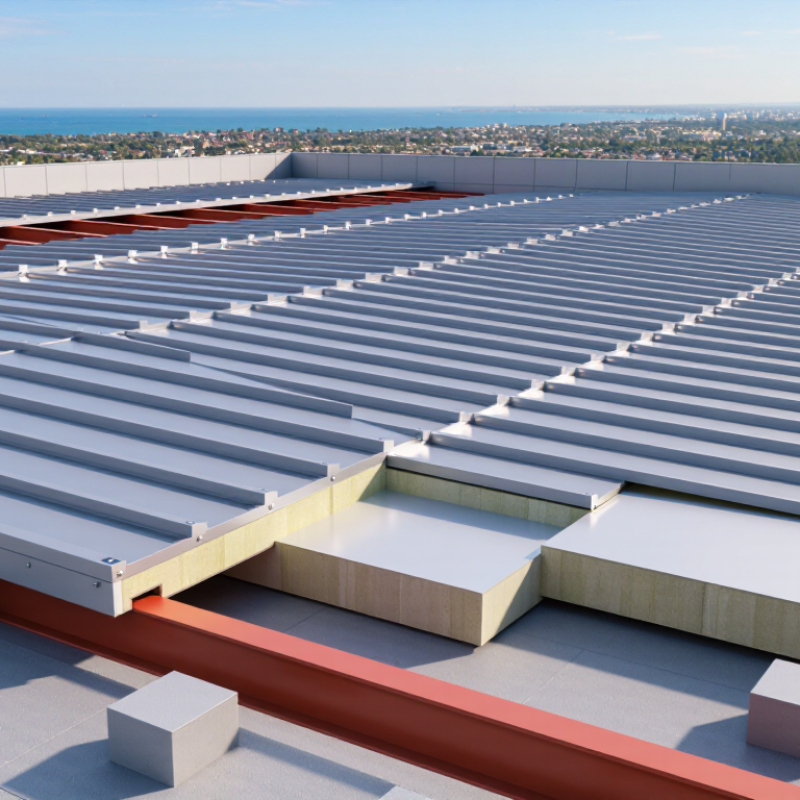
Define the Roof’s Climate, Building, and Performance Requirements
A metal sandwich panel roof should be selected for the building’s actual exposure, not just its appearance. NOAA’s 1991–2020 U.S. Climate Normals provide 30-year averages for temperature and precipitation; check the nearest station and local extremes. A coastal site may need stronger corrosion resistance, while a high-snow area needs suitable structural capacity. Wind exposure matters too. A sheltered warehouse and an open hillside are not the same design problem.
Then define indoor conditions and operating needs. Will the building store temperature-sensitive goods, house livestock, or face high humidity? Specify insulation, air sealing, vapor control, drainage, and fire performance with a qualified designer. The U.S. Department of Energy reports that cool roofs can be over 50°F cooler than conventional roofs during peak summer weather. That figure describes roof-surface temperatures, not a guaranteed indoor-energy saving. Color alone will not solve poor detailing.
Tips: Ask for project-specific wind and snow-load calculations, panel thermal data, and condensation-control details. Check seams, fasteners, and roof penetrations on the drawings. Small gaps matter. I would not assume a published R-value predicts field performance; installation quality and thermal bridges can change the result. Recheck assumptions before ordering.
Compare Core Materials, Thermal Ratings, and Panel Thicknesses
How to Choose the Best Metal Sandwich Panel Roof in 2026?
Compare Core Materials, Thermal Ratings, and Panel Thicknesses
Start with the core, not the color. The U.S. Department of Energy’s Energy Saver guidance lists rigid foam insulation at roughly R-3.8 to R-6.5 per inch, depending on material. Polyisocyanurate generally delivers more thermal resistance per inch than expanded polystyrene. Mineral wool is another option where fire performance matters, though its thermal rating and panel weight should be checked in the product data. Ask for tested values, not estimates. Small differences matter.
Panel thickness affects more than the nominal R-value. A thicker core can improve thermal resistance, but seams, fasteners, and roof edges can create heat-loss paths. ASHRAE’s 2024 Handbook—Fundamentals explains how thermal bridges affect whole-assembly performance. Compare the panel’s tested U-factor with the roof target for your climate and building use. Check span tables, too: a thermal upgrade may change structural requirements. A tidy rating chart can still hide awkward details.
Tips: Request the test standard, core type, thickness, and assembly U-factor on one sheet. Check joint details against the roof drawings. I would recheck the numbers after installation plans change; drawings are not always as neat as the brochure.
Assess Metal Skins, Coatings, Profiles, and Weather Resistance
Choose the metal skins for the building’s exposure, not just its appearance. Steel skins are often selected for strength and value, while aluminum can be useful where lower weight or corrosion resistance matters. Compare the specified metal thickness, protective layer, and cut-edge treatment. A thin skin may dent more easily during handling. Check the panel data sheet, and ask how repairs should be made.
Coatings face different demands. Strong sunlight can fade some finishes, while salt air and persistent moisture can accelerate corrosion if protection is inadequate. Match the coating specification to the site conditions, including nearby industrial emissions and frequent wetting. Then inspect the panel profile: raised ribs and well-formed side laps help shed rain, while shallow channels can hold debris. Small details matter.
Weather resistance depends on more than the panel itself. Confirm that roof pitch, fasteners, closures, and flashing suit the expected wind and rainfall. In snowy regions, consider how the profile handles drifting and how the roof structure carries the load. This is easy to underestimate. I would also check how installers protect exposed edges during cutting; a good factory finish cannot prevent every site mistake. Compare tested performance with local design requirements, and get the full assembly reviewed before ordering.
How to Choose the Best Metal Sandwich Panel Roof in 2026?
Compare common zinc-coating designations as one part of assessing weather resistance.
Z coating values indicate nominal coating mass in grams per square metre across both sides of the steel sheet. A higher value does not translate directly into a specific service life: exposure, cut edges, detailing, and maintenance also matter. Choose metal-skin thickness and panel profile to meet the project’s wind, snow, and span requirements.
Verify Structural Capacity, Fire Safety, and Building-Code Compliance
How to Choose the Best Metal Sandwich Panel Roof in 2026?
A roof panel’s strength depends on more than its metal skins. Check its tested load capacity against the project’s clear spans, support spacing, and design loads. Snow, wind uplift, maintenance access, and equipment can all affect performance. Ask for span tables and engineering data for the exact panel thickness and fixing pattern.
A span table is not a substitute for project-specific design. That distinction matters.
Fire safety deserves equal scrutiny. Review test documentation for the complete roof assembly, not just the insulation core. Panel joints, coatings, roof deck, and installation details can change how a system performs. Confirm the required fire classification with the local building authority and design team. Do not assume that a non-combustible facing makes the whole assembly fire-safe.
Small details count.
Check building-code requirements before ordering panels. Confirm applicable rules for structural loads, fire performance, energy efficiency, drainage, and roof penetrations. Codes and amendments vary by location, and requirements can change. Have a qualified design professional verify that the proposed assembly, fasteners, and supporting frame match the project documents. Keep test reports, calculations, and installation instructions on file.
Paperwork can feel tedious, but missing evidence may delay approval.
The right panel is the one that meets verified project needs, not merely the one with the strongest headline rating.
Compare Installation Needs, Lifecycle Costs, and Warranty Coverage
Choosing a metal sandwich panel roof starts with the building, not the panel brochure. Check roof pitch, support spacing, drainage paths, and local wind or snow demands with a qualified designer. Panels are bulky, so confirm crane access and safe handling space before delivery. A narrow access road can turn a simple installation into an expensive delay. Details matter.
Installation quality affects performance. Align panel joints carefully, use the specified fasteners, and seal penetrations around vents and skylights. Poorly fitted flashings can let water reach the core, even when the panels themselves are sound. Ask installers how they manage condensation, cut edges, and damaged coatings. Those details are easy to overlook on a busy site.
Compare lifecycle costs, not just purchase prices. A higher initial cost may be worthwhile if the roof needs less maintenance or reduces heat loss, but actual savings depend on climate and building use. Include inspections, cleaning, repairs, and eventual replacement in the estimate. Read warranty terms closely: coverage may depend on approved installation methods, maintenance records, and limits for corrosion or water entry. Get exclusions in writing. I would also keep installation photos and product documents together; they can be harder to find years later. No estimate is perfect. Recheck assumptions before ordering.
| Comparison factor | EPS-core panel | PIR/PUR-core panel | Mineral-wool-core panel |
|---|---|---|---|
| Typical core thermal conductivity | Approximately 0.035–0.040 W/(m·K); verify the declared value for the selected product. | Approximately 0.022–0.028 W/(m·K); product formulation and test method affect the declared value. | Approximately 0.035–0.045 W/(m·K); density and product construction affect the declared value. |
| Relative initial cost | Usually lower. Check local pricing, panel thickness, metal gauge, coating, and accessory costs. | Usually medium. Higher thermal performance per unit thickness may help where roof depth or weight is constrained. | Usually medium to higher. Added panel weight and fire-performance requirements can affect supply and installation costs. |
| Installation needs | Relatively light panels can simplify handling. Correct support spacing, fastener selection, joint sealing, and condensation control remain essential. | Typically manageable panel weight. Follow the system’s lifting, fixing, joint, and flashing details; avoid damage to panel edges and facings. | Heavier panels may require more lifting capacity, careful handling, and suitable structural checks. Install joints and flashings exactly to the system details. |
| Fire-performance considerations | EPS is combustible. Confirm the required building-code classification and assess the complete roof assembly, not just the panel core. | Fire behavior varies by formulation and assembly. Obtain product-specific test evidence and confirm compliance with applicable codes. | Mineral-wool core is generally non-combustible; verify the panel’s tested classification, facings, joints, and complete assembly requirements. |
| Lifecycle-cost drivers | Lower purchase price may be offset if project requirements call for additional fire protection or greater insulation thickness. Include energy, maintenance, and replacement costs. | Compare upfront cost with expected heating and cooling savings for the building’s climate and operating schedule. Account for air leakage, thermal bridges, and maintenance. | May suit projects where fire performance and acoustic absorption are priorities. Include structural, lifting, energy, and maintenance costs in the comparison. |
| Service-life planning | There is no universal service life based on core type alone. Roof life depends heavily on metal coating, exposure, drainage, joint design, installation quality, and maintenance. Use a project-specific life-cycle assessment rather than treating a panel estimate as a guarantee. | ||
| Warranty coverage to compare | Review separate written terms for the metal finish, panel integrity, and roof weathertightness. Confirm the warranty period, start date, permitted use, coastal or industrial exposure limits, installation requirements, maintenance duties, exclusions, and remedies. A coating warranty does not automatically cover leaks or the whole roof assembly. | ||
| Best suited to | Projects with a tight first-cost target where the applicable fire and thermal requirements can be met. | Projects prioritizing strong insulation performance with comparatively modest panel thickness. | Projects where non-combustible core properties or acoustic performance are important design criteria. |
Planning note: Values and cost rankings are indicative, not product guarantees. Confirm declared performance, code compliance, local installed pricing, structural requirements, and warranty terms with project-specific documentation before selection.