What Are Lifting Blocks and How Do They Work?
Lifting Blocks are compact mechanical systems that guide rope or wire rope around grooved sheaves. They can redirect a load or improve lifting advantage. However, the visible pulley is only part of the calculation.
A single fixed block changes direction, but it does not reduce the load’s weight. A movable block can share the load across rope sections. In ideal conditions, two supporting rope parts can approach a 2:1 mechanical advantage. Friction, rope bending, poor reeving, and unequal loading reduce that benefit. Small details matter. A twisted rope can alter the entire lift.
The International Labour Organization estimates that almost three million workers die annually from work-related causes. Its report does not isolate Lifting Blocks, but it reinforces a wider point: equipment design cannot replace competent planning. Britain’s Health and Safety Executive recorded 124 worker fatalities during 2024/25, showing why lifting controls deserve practical attention.
Ross Moloney, former chief executive of the Lifting Equipment Engineers Association, states, “Safe lifting starts with competent people, suitable equipment, and proper planning.” That principle remains useful, although it is incomplete without inspection and load-path analysis.
ASME B30.26 provides guidance for rigging hardware, while OSHA rules address inspection and safe operation of lifting equipment. These references help explain working load limits, identification markings, sheave condition, and connecting hardware.
This guide examines how Lifting Blocks work, where mechanical advantage can be misunderstood, and which visible warning signs demand a closer inspection. Real lifting rarely behaves perfectly. That is the part worth remembering.
Definition and Purpose of Lifting Blocks
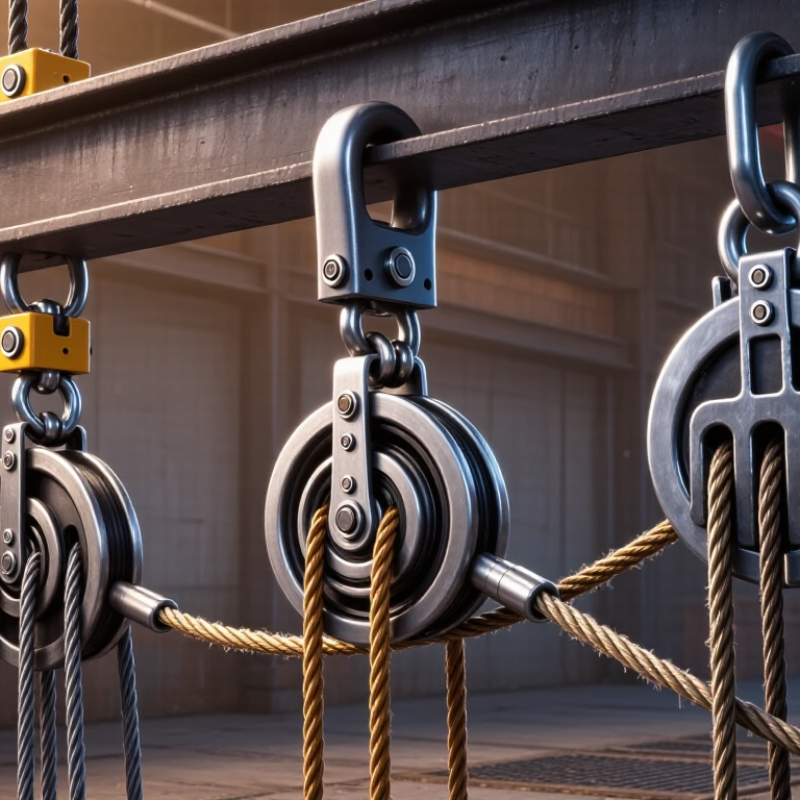
Lifting blocks are mechanical assemblies that guide and multiply lifting force. A typical block contains one or more grooved sheaves, an axle, side plates, and a hook or shackle. The lifting rope runs around the sheaves. This changes the rope direction and can reduce the pulling force required to raise a load.
A fixed block mainly redirects force. A movable block shares the load between rope sections and provides mechanical advantage. More supporting rope sections usually mean less line pull. However, the operator must pull more rope, and friction reduces the theoretical advantage. It is not magic. A 2:1 arrangement may deliver less than 2:1 in real conditions.
The main purpose is controlled lifting, positioning, and load alignment in workshops, construction areas, and maintenance operations. Correct selection depends on working load limit, rope diameter, sheave condition, hook design, and lifting angle. The assembly must match the rope and remain vertically aligned with the load. Side loading can damage the frame or dislodge the hook.
The block is not a safety device by itself. A 2023 International Labour Organization report estimated nearly three million work-related deaths annually, showing why basic lifting controls matter. The U.S. Bureau of Labor Statistics recorded 1,053 fatal work injuries in transportation and material-moving occupations in 2023. These figures do not prove that lifting blocks cause incidents. They do show the cost of weak procedures. In practical inspections, worn sheaves and unclear load ratings remain easy mistakes. Regular checks against applicable ASME standards and site procedures are essential.
Main Components and Structural Design
Lifting blocks are compact pulley assemblies that redirect rope and multiply mechanical advantage. Their structure usually includes side plates, a sheave, an axle, bearings, a hook or eye, and a safety latch. The sheave carries the rope in a carefully shaped groove. Its diameter matters. A small sheave bends wire rope sharply, increasing fatigue and shortening service life.
Design begins with the working load limit, not the appearance. Engineers check the frame, axle, bearings, hook, and fasteners as one load path. A two-sheave block can reduce operator effort, but rope friction lowers the ideal mechanical advantage. A practical reeving system may deliver less than 90% of its theoretical gain. That gap is easy to overlook. The block also needs side plates that resist spreading when the rope enters at an angle. Misalignment creates uneven pressure and accelerates wear.
The U.S. Bureau of Labor Statistics recorded 5,283 fatal occupational injuries in 2023 across all industries, showing why load-control details deserve serious attention. This figure does not describe lifting blocks alone, but it reflects the broader risk around industrial work. ISO 4309 recommends structured wire-rope inspection, while ASME B30.26 addresses rigging hardware requirements. Operators should verify markings, inspect cracks and deformation, and confirm that the rope sits fully inside the groove. Field experience suggests that lubrication and alignment are often neglected. That is a design weakness, too. A technically strong block can still fail when inspection access is poor or instructions are unclear.
How Lifting Blocks Operate Step by Step
What Are Lifting Blocks and How Do They Work?
Lifting blocks are mechanical assemblies that guide and redirect wire rope during lifting operations. They usually contain one or more grooved wheels, called sheaves, mounted inside a strong frame. A hook, swivel, or attachment point connects the block to the load or supporting structure. Their design can increase lifting capacity by sharing the load across several rope sections.
How Lifting Blocks Operate Step by Step
The wire rope first passes around the sheaves. As the hoist pulls the rope, each sheave rotates on its bearing. This reduces sliding friction and helps the rope travel smoothly. When the block has multiple sheaves, the rope forms several supporting parts between the block and the fixed point. The load then moves more slowly, but the lifting force improves. For example, two supporting rope parts can nearly double mechanical advantage, although friction reduces the real result. That detail is easy to overlook.
The operator should confirm the block’s rated capacity before lifting. Inspect sheaves, bearings, side plates, pins, hooks, and rope grooves for damage or unusual wear. Make sure the rope sits correctly inside every groove. Never stand beneath a suspended load. Keep movements controlled, because sudden loading can exceed expected forces.
Tips: Keep the rope aligned with the block. Avoid side pulling. Lubricate only according to the equipment instructions. Record inspections, and replace damaged parts instead of relying on appearance alone. Small cracks can hide serious weakness.
What Are Lifting Blocks and How Do They Work?
A lifting block uses pulleys and rope to trade pulling distance for reduced lifting force.
The chart shows the ideal input force required to raise a 1,000 kg load as the number of
supporting rope parts increases. Values are calculated using a gravitational acceleration
of 9.81 m/s² and exclude friction.
Step by step, the rope is anchored or routed through the blocks, the moving block supports
the load, and each supporting rope part shares the load. With two supporting parts, the
ideal mechanical advantage is 2:1; with four parts it is 4:1, and so on. Real systems
require more force because of pulley friction, rope bending, alignment, and block weight.
Common Types and Their Practical Applications
What Are Lifting Blocks and How Do They Work?
Lifting blocks use a grooved wheel, called a sheave, to guide rope or wire cable. The block changes pulling direction and can increase mechanical advantage. A single fixed block mainly redirects force. A movable block shares the load across supporting rope sections. A compound system can lift heavier materials with less pulling effort, although it requires more rope movement.
Common types serve different practical applications. Snatch blocks have a side-opening cheek plate, allowing quick cable installation during winching or recovery work. Fixed pulley blocks suit workshops, stage equipment, and light material handling. Chain blocks use hand-operated chains for controlled vertical lifting on construction sites and maintenance floors. Swivel blocks help manage changing load directions, while lifting blocks used with cranes support guided, suspended loads. The correct choice depends on working load limit, rope diameter, lift angle, and expected shock loading. According to the International Labour Organization’s 2023 report, work-related factors cause about 2.93 million deaths and 395 million nonfatal injuries annually. That figure makes small rigging decisions less small. A block may look strong while its pin, hook, or sheave is already damaged.
Tips: Inspect the frame, hook, latch, sheave, and rope before every lift. Confirm the working load limit from the manufacturer’s marking. Keep people outside the suspended-load zone. Never assume a two-part line doubles capacity perfectly; friction and poor alignment reduce the gain. ASME B30.26 guidance also supports routine inspection of rigging hardware. My own practical concern is simple: operators often check visible cracks first, but deformation can be harder to notice.
Safety Factors, Load Limits, and Maintenance Needs
A lifting block is a pulley assembly that guides wire rope and may multiply lifting force. Its sheaves rotate around an axle, while side plates keep the rope aligned. The marked working load limit, or WLL, is the controlling figure. Physical size is not proof of capacity. Rope diameter, sheave condition, hitch arrangement, and lifting angles can change the real load.
Safety factors protect against uncertain conditions, but they do not permit overloading. ASME B30.26 guidance treats rated capacity, identification, inspection, and deformation control as essential rigging concerns. The WLL must also account for shock loading, side loading, uneven rope seating, and worn bearings. These details are easy to overlook. In the United States, the Bureau of Labor Statistics recorded 5,283 fatal workplace injuries in 2023. The figure is not specific to lifting blocks, but it shows why assumptions deserve scrutiny.
Maintenance should begin before each shift. Check the hook, latch, cheek plates, pins, grooves, and bearings for cracks, bending, corrosion, or unusual wear. A seized bearing can increase rope tension quickly. Remove the block from service when markings are unreadable or parts show permanent deformation. The International Labour Organization estimated 2.93 million work-related deaths globally in its 2024 safety report. A clean checklist helps, but it cannot replace trained judgment. Sometimes, the honest answer is uncertainty. Stop the lift and obtain a competent inspection.