
Top 10 Grinding Steel Ball Manufacturers in the World
Grinding Steel Balls are small components with a large industrial role. In mining, they help reduce hard ore inside rotating mills, where impact, abrasion, and constant load test each ball’s durability. Buyers therefore look beyond price. Hardness, wear rate, diameter consistency, and supply reliability matter on the plant floor.
The scale of related industries is substantial. World Steel Association data puts global crude steel production at about 1.88 billion tonnes in 2024. The USGS Mineral Commodity Summaries 2025 estimates that worldwide copper mine production reached roughly 23 million metric tons that year. These figures do not measure grinding-ball demand directly. They do, however, show the scale of steelmaking and mineral processing sectors that depend on reliable industrial inputs.
This guide to the Top 10 Grinding Steel Ball Manufacturers in the World compares producers through practical considerations: product range, manufacturing capability, quality controls, and international supply experience. A buyer may need forged balls for a high-impact mill, or cast balls for a different operating profile. The best choice depends on ore hardness, mill conditions, and operating data—not a polished brochure alone. Details can vary by plant and batch. That is worth remembering. No ranking can replace a site trial, verified specifications, and a careful review of service performance.
What Grinding Steel Balls Are and Where They Are Used
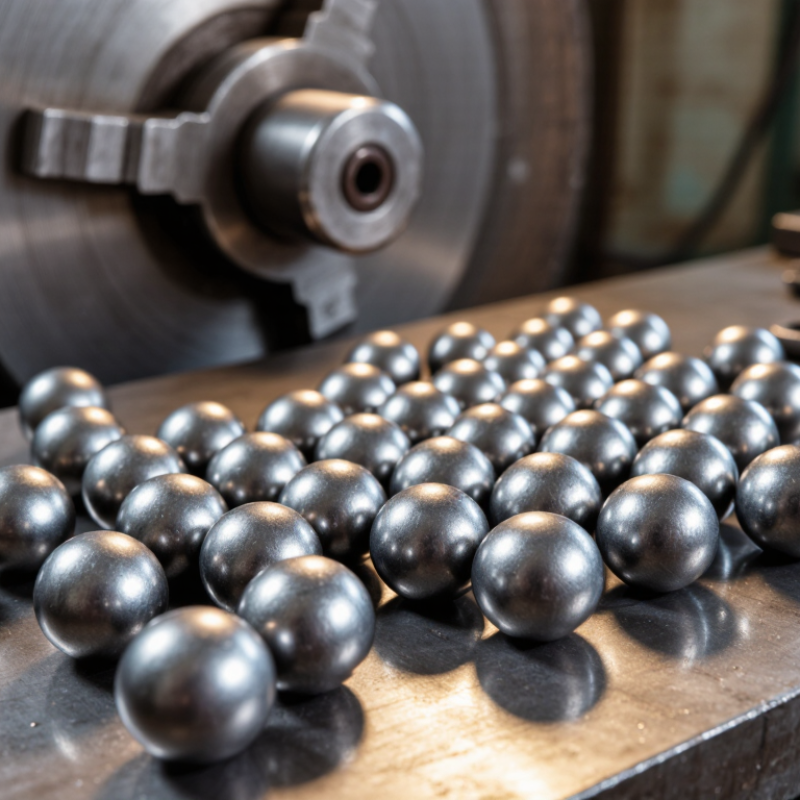
Grinding steel balls are hardened metal spheres used as grinding media inside rotating mills. As the mill turns, the balls lift and fall, breaking ore or other feed through impact and abrasion. Their diameter, hardness, and resistance to wear affect how efficiently material is reduced. Small details matter. A ball that is too soft may wear quickly, while an unsuitable size can leave particles too coarse or consume excess energy.
These balls are widely used in mining and mineral processing, including mills that treat copper, gold, and iron ores. Cement plants also use them to grind clinker into fine powder. In each setting, the feed material and mill conditions shape the choice of ball size and hardness. Operators may check worn media, mill noise, and product fineness to spot changes in performance. Results vary with ore properties and operating practices, so one specification rarely suits every mill. It is tempting to make selection sound simple; in practice, it often takes measured trials and careful adjustment.
Grinding Steel Balls: Hardness of Minerals Commonly Processed
Grinding steel balls are used in tumbling mills to break down mineral feed. This chart shows representative Mohs hardness values for minerals found in common grinding applications; actual ore hardness varies with its mineral composition.
How Grinding Steel Ball Manufacturers Are Evaluated
A credible comparison starts with the mill, not a supplier’s sales sheet. Ball diameter, alloy chemistry, hardness, and heat treatment must match the ore, mill speed, and slurry conditions. Ask for hardness readings across a ball’s cross-section, not only at the surface. A hard shell can hide a softer core. Check impact toughness and microstructure, too; brittle balls may crack or spall before wear savings appear. ASTM wear-test results can help, but laboratory conditions rarely reproduce every mine or cement circuit. They are evidence, not a guarantee.
Production consistency matters as much as peak performance. Request test records from several batches, including chemical analysis, hardness, and dimensional checks. Verify that samples represent normal production, and ask how rejected lots are handled. The USGS Mineral Commodity Summaries 2024 estimates global cement production at about 4.1 billion metric tons in 2023, underscoring the scale of applications that rely on dependable grinding media. Still, that figure says nothing about an individual supplier’s quality. Compare wear rate, breakage, mill throughput, and energy use in a controlled site trial. Keep the ore and operating conditions as consistent as possible. A polished certificate is not enough. I would also examine delivery reliability and technical support; these are harder to score, but a missed shipment or slow troubleshooting can outweigh a small price advantage.
Profiles of the Top 10 Grinding Steel Ball Manufacturers
A useful comparison looks beyond production volume. One manufacturer may integrate steelmaking and ball production. Another may specialize in forged media for large mineral-processing mills. Several focus on high-chrome cast balls, while others serve cement plants or regional export markets. Some offer custom diameters and hardness ranges. Others emphasize automated heat treatment, laboratory testing, or close technical support. These profiles describe different strengths, not a verified ranking. Capabilities vary by product and facility.
Tips: Ask for test data on hardness, impact resistance, and wear rate. Match the ball material to your mill, ore, and operating conditions. A catalog alone is not enough.
Reliable manufacturers can explain how their process controls size, surface quality, and internal structure. Look for consistent batch records and practical guidance on trial quantities. Ask how performance is measured under conditions similar to yours. A polished specification sheet helps, but real mill results matter more. Even a well-made ball can disappoint when the size or alloy is poorly matched. A neat ranking can mislead; procurement teams should verify each supplier’s claims directly.
Top 10 Grinding Steel Ball Manufacturers in the World – Profiles of the Top 10 Grinding Steel Ball Manufacturers
About this table: Company names are omitted. Since no source articles or verifiable company-level data were provided, these are non-ranked, representative manufacturer profiles based on established grinding-media production methods and applications—not claims about ten specific companies.
| Profile | Typical manufacturing route | Common product characteristics | Typical applications | Relevant production and quality checks |
|---|---|---|---|---|
| Profile 1 Forged-media specialist | Steel bar or billet is heated, formed by forging, and then heat-treated. | Forged steel balls; chemistry, diameter, and hardness are selected to suit the mill and operating conditions. | Mining and mineral-processing mills, including applications requiring impact-resistant grinding media. | Checks may include dimensional inspection, hardness testing, metallographic examination, and impact or drop testing. |
| Profile 2 High-chromium cast-media producer | Alloyed molten iron is cast into ball-shaped moulds and heat-treated as required. | Cast balls with chromium-alloyed compositions; wear and impact performance depend on the alloy and heat treatment. | Cement production, mineral processing, and other grinding circuits where cast media is specified. | Typical controls include chemical analysis, hardness testing, microstructure checks, and visual inspection for casting defects. |
| Profile 3 Low-chromium cast-media producer | Molten iron with a lower chromium content is cast and processed to the customer's specification. | Cast grinding balls designed for applications where the selected alloy and operating cost balance is appropriate. | Selected cement and mineral-processing mills, subject to the mill design and site's operating conditions. | Quality checks commonly cover chemistry, dimensions, hardness, surface condition, and batch traceability. |
| Profile 4 Mining-focused media supplier | May use forging, casting, or both, depending on the required media type and customer specification. | Grinding balls selected for ore type, mill configuration, grinding conditions, and desired media life. | Ore grinding in mineral-processing operations, including tumbling-mill circuits. | Product qualification can include hardness distribution, impact resistance, wear trials, and review of operating data. |
| Profile 5 Cement-industry media supplier | Typically produces cast or forged media according to the cement plant's mill and operating requirements. | Media grades and dimensions are specified to match the grinding stage and mill conditions. | Raw-material, clinker, and other cement-related grinding duties, depending on plant configuration. | Common checks include size grading, chemistry, hardness, visual inspection, and consistency between production batches. |
| Profile 6 Integrated steel-to-media producer | Controls several stages of production, potentially including steelmaking, forming, heat treatment, and inspection. | Product consistency can be managed across stages when process controls and traceability are maintained. | Industrial grinding-media supply for mining, cement, and other processing industries. | Controls may include incoming-material verification, process monitoring, heat-treatment records, and final-product testing. |
| Profile 7 Custom-specification manufacturer | Manufactures to agreed drawings, material requirements, and inspection plans using a suitable forming route. | Dimensions, alloy selection, and acceptance criteria are set by the purchase specification rather than a universal grade. | Plants with particular mill designs, feed materials, or operating requirements. | Inspection plans may define sampling, dimensional tolerances, test methods, documentation, and batch identification. |
| Profile 8 Large-diameter media producer | Uses a forming and heat-treatment process selected for the required ball size and material. | Larger media are specified for compatible mill designs and operating conditions; availability varies by producer. | Large tumbling mills and other circuits designed for larger grinding media. | Checks may emphasize internal soundness, hardness distribution, dimensional accuracy, and resistance to cracking. |
| Profile 9 High-volume production supplier | Uses repeatable production lines for recurring orders, with process controls suited to the chosen product route. | Offers defined product grades and size options; exact range and capacity are supplier-specific and should be confirmed. | Ongoing supply programs for industrial users with regular media-replacement needs. | Relevant controls include batch records, process monitoring, statistical checks, final inspection, and shipment documentation. |
| Profile 10 Export-oriented grinding-media supplier | Produces forged or cast media and coordinates packaging, documentation, and shipment for overseas customers. | Product specification, packaging, and documentation are agreed for each order and destination. | International mining, cement, and industrial customers, subject to import and transport requirements. | Purchasers commonly verify test certificates, product identification, packing details, and applicable contractual requirements. |
How Grinding Steel Balls Are Made and Quality-Tested
Grinding steel balls may be forged from heated steel bar or cast from molten alloy. In forging, cut billets are heated, pressed into spheres, then quenched and tempered. Casting pours molten metal into molds before heat treatment. The route affects internal structure and performance. World Steel Association’s World Steel in Figures 2024 reports 1,892.2 million tonnes of crude steel production in 2023. That figure gives useful industry context, but it is not a grinding-ball quality benchmark.
Quality checks should cover more than surface appearance. Manufacturers may verify chemical composition, diameter, roundness, hardness, and internal flaws. Hardness testing can use ASTM E10 or E18 methods, depending on the chosen scale. Metallographic examination helps reveal grain structure and heat-treatment consistency. Impact or drop testing can assess resistance to cracking during service. Sampling plans matter: one flawless ball cannot represent an entire batch. A test can also miss defects, so results need careful interpretation.
Tips: Ask for batch-level test records, including sample size and hardness locations. Look for checks on both the surface and the core. A polished ball is not necessarily a reliable one.
How to Choose a Grinding Steel Ball Supplier
Choosing a grinding steel ball supplier starts with your ore and mill conditions, not a catalogue price. Ball diameter, alloy chemistry, hardness, and impact toughness affect wear and breakage. Ask for batch-level test certificates and clear details about heat treatment. Ask for evidence. The International Copper Study Group’s World Copper Factbook 2024 estimates global copper mine production at about 22.4 million tonnes in 2023. This is not a grinding-media demand figure, but it indicates the scale of mineral processing behind supplier competition.
Compare suppliers using measurable results: ball consumption per tonne of feed, mill power, product size, and unplanned downtime. Request samples from the proposed production batch, then run a controlled trial against your current media. Keep ore type, feed size, and operating conditions consistent. Otherwise, the comparison may mislead. Fit matters.
Check how the supplier controls sizing, chemistry, and hardness variation across each batch. Confirm packaging, delivery intervals, and procedures for investigating premature breakage. Ask for references from mills with similar ores and grinding circuits, then verify the operating details directly. A low purchase price can look attractive while raising replacement and handling costs. Still, no spreadsheet captures every shift in ore hardness; review trial data with operators before committing to larger volumes.