Top Lifting Supply Companies for Global Buyers?
Choosing the right Lifting Supply company can determine whether a project runs smoothly or faces costly delays. Global buyers need more than attractive prices. They need verified products, clear documentation, responsive support, and dependable delivery.
Ross Moloney, a recognised lifting-industry leader and former LEEA chief executive, once stated, “Safety is the foundation of every successful lifting operation.” This principle remains practical. A reliable supplier should explain working load limits, inspection intervals, material grades, and certification requirements. Buyers should also check whether product markings remain readable after transport and handling. Small details matter.
The strongest companies usually offer slings, shackles, hoists, lifting clamps, spreader beams, and engineered solutions. They understand that a coastal warehouse may require different protection than an inland factory. They also provide traceability from production to final shipment. That is valuable.
Still, no supplier is perfect. Some websites look impressive but provide thin technical information. Others promise global coverage without local service. This is where careful comparison becomes essential. Buyers should examine manufacturing experience, independent testing, after-sales assistance, and communication quality. References from similar industries can reveal more than polished brochures.
This guide highlights leading Lifting Supply companies for international buyers. It considers product depth, technical competence, quality controls, delivery capability, and customer support. The ranking is not absolute. Requirements differ between construction sites, ports, energy facilities, and manufacturing plants. A thoughtful buyer should verify every specification before placing an order. That extra step may feel slow, but rushed lifting decisions can become expensive lessons.
Global Lifting Equipment Market: 5.2% CAGR Forecast Through 2030 (GMI)
Global lifting equipment demand is entering a measured expansion phase. Global Market Insights forecasts a 5.2% CAGR through 2030. This growth reflects investment in construction, ports, warehouses, energy projects, and manufacturing upgrades.
Demand is becoming more specific. A busy warehouse may need compact electric hoists, precise controls, and low maintenance. A steel facility may require higher duty ratings, heat resistance, and longer operating cycles. Buyers should compare safe working load, lift speed, headroom, power supply, and service access. Small details matter.
They really do.
Industry reports from Grand View Research also identify automation and material-handling modernization as important market drivers. However, forecasts are not guarantees. Currency changes, delayed infrastructure projects, and technician shortages can alter purchasing plans. This point is easy to overlook.
Experienced buyers should request test certificates, inspection records, load-test procedures, spare-parts availability, and operator training details. These documents reveal more than a polished product sheet. They also support safer purchasing decisions across different jurisdictions.
A practical sourcing process includes site measurements and duty-cycle calculations. For example, a five-ton system used intermittently differs greatly from one operating every few minutes. Treating them as identical creates avoidable risk. The market may grow steadily, but equipment selection still requires careful engineering judgment.
Product Scope: Cranes, Hoists, Slings, Shackles, and Lifting Magnets
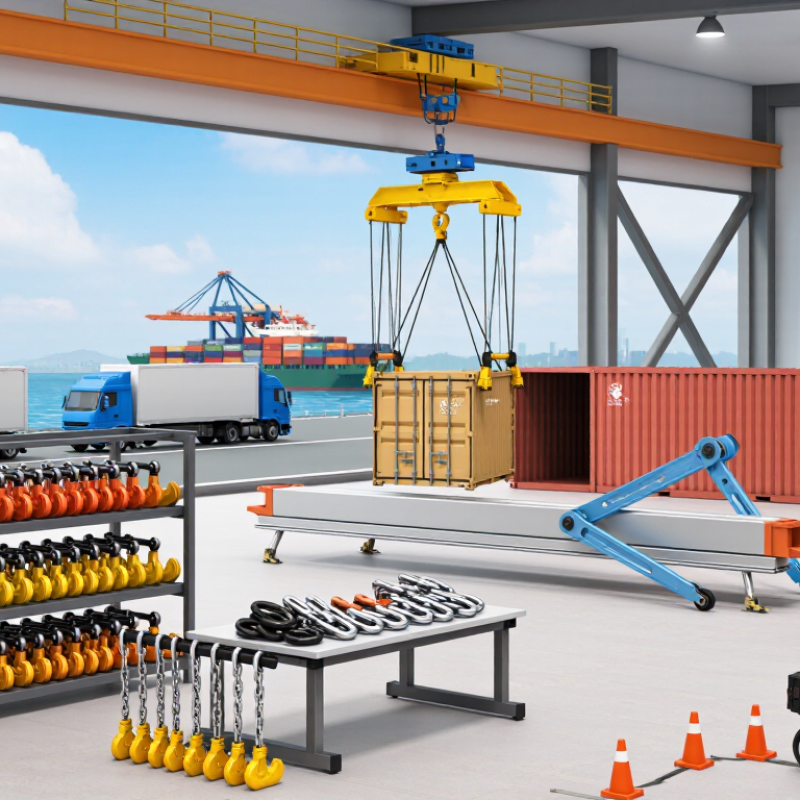
Global buyers need lifting supply companies that understand complete handling systems, not isolated products. A reliable supplier should offer cranes, hoists, slings, shackles, and lifting magnets with clear load ratings. Product drawings, inspection records, material certificates, and maintenance guidance should be easy to obtain. These details reveal technical discipline.
For cranes and hoists, check duty classification, lifting speed, travel range, controls, and emergency stopping features. A ten-ton overhead crane may suit a factory, while a compact electric hoist may fit a repair bay. Slings and shackles require accurate working load limits, traceable identification, and durable markings. Lifting magnets need tested holding capacity, suitable surface conditions, and secure release controls. Small details matter.
Tips:
Ask suppliers for sample certificates and inspection procedures before ordering. Compare working load limits, not only prices. Confirm packaging for humid sea transport. Request installation drawings and spare-parts support. Keep records.
Supplier selection is rarely perfect. Some catalogs look impressive but provide weak technical answers. That is a warning sign. An experienced buyer should test response quality, not just product range. Ask how the supplier handles damaged slings, uncertain loads, or changing site conditions. Good guidance should be practical, measured, and honest about limitations. Avoid suppliers that promise one solution for every lifting task. Real workplaces are messier.
Safety Benchmarks: OSHA, ASME B30, EN 13155, ISO 9001, and CE
For global buyers, lifting suppliers should prove safety through documented controls, not attractive catalogs. OSHA rules, including 29 CFR 1910.184, require proper sling selection, inspection, and removal of damaged equipment. OSHA is a United States framework, but its inspection logic is useful internationally. The ILO estimated 2.93 million work-related deaths in 2019, reported in its 2023 global study. That figure makes traceability more than paperwork.
ASME B30 provides practical guidance for cranes, slings, hooks, and below-the-hook devices. EN 13155 focuses on non-fixed load lifting attachments, including marked working load limits and safe operating conditions. Buyers should request test records, material certificates, inspection intervals, and clear instructions. Small details matter. A missing serial number can weaken an otherwise strong quality file.
ISO 9001 certification indicates a controlled management system, not automatic product safety. The ISO Survey 2022 recorded 1,265,216 ISO 9001 certificates worldwide, showing broad adoption but not equal technical competence. CE marking confirms applicable European conformity requirements; it is not a universal quality label. Suppliers should identify relevant directives, risk assessments, and declarations of conformity. I have seen compliance files that look complete but lack field evidence. That gap deserves uncomfortable questions.
Supplier Comparison: SWL, Safety Factors, Test Loads, and Certification Data
Global lifting supply companies should be compared through usable evidence, not catalog promises. Start with the safe working load, or SWL, shown for the exact configuration. A sling rated for one angle may carry less at another angle. Fittings, hooks, and connectors also affect the final capacity. Check the material grade, dimensions, batch number, and intended lifting method.
Safety factors require careful reading. A product may have a 5:1 or 7:1 design ratio, but that ratio does not increase the permitted SWL. It describes the relationship between breaking strength and working capacity. Test loads can create confusion. A proof test confirms performance under a specified load. It does not prove unlimited reuse or resistance to every site condition. Ask for the test method and applied load.
Look for certification data that is traceable and current. Reliable documents identify the manufacturer, product serial number, inspection date, standard, test equipment, and authorized signatory. Compare these details across suppliers. Missing records matter. A polished certificate can still hide weak traceability. Field checks should confirm labels, stitching, pins, welds, and visible damage before use. Small discrepancies deserve attention. I have seen buyers focus on price and overlook angle ratings. That mistake is understandable, but costly. Supplier comparisons should record every assumption, because lifting calculations rarely fail in neat ways.
Lifting Standard Comparison for Global Buyers
Reference comparison of minimum design factors and proof-test loads commonly specified for lifting slings. SWL/WLL means the maximum permitted working load under the stated configuration.
A higher design factor indicates a greater ratio between minimum breaking force and rated working load. A proof-test value of 2.0 means testing at twice the rated SWL/WLL where specified. Certification and inspection requirements must still be verified against the applicable product standard, conformity-assessment route, and local regulations.
Reference standards: EN 1492-1 and EN 1492-2 for textile slings, EN 13414-1 for wire-rope slings, and ASME B30.9 for slings. Values shown are standard reference points, not supplier-specific claims.
Global Buyer Shortlist: Capacity, Lead Time, Regional Service, and Total Cost
Top Lifting Supply Companies for Global Buyers?
Global lifting procurement is rarely decided by price alone. Capacity claims need practical verification. A supplier may list a 50-ton rating, yet the complete system may require lower limits. Ask for load charts, inspection records, material traceability, and recent test documentation. These details show whether quoted capacity matches the intended lift. Small gaps matter.
Lead time should include production, inspection, export preparation, and inland delivery. A ten-day factory estimate may become five weeks at the jobsite. Regional service can reduce this uncertainty through local technicians, replacement parts, and time-zone support. Check response times before placing an order. Fast communication helps, but it does not replace technical competence.
Total cost should include freight, duties, installation, training, maintenance, and possible downtime. A lower purchase price can become expensive when spare parts arrive slowly. I once treated delivery speed as a fixed number; that assumption was too simple. Weather, port congestion, and approval delays changed the result. A stronger shortlist compares capacity, verified lead time, regional support, and landed cost in one transparent worksheet. Procurement teams should also record exclusions, because unclear assumptions often create the final expense.