
Why Choose a 180 Degree Concealed Hinge?

A cabinet door that opens wide can make everyday tasks easier. A 180 Degree Concealed Hinge is designed to let a door swing farther than many standard concealed hinges, while keeping its mechanism out of sight when the door is closed. This can help when reaching into a deep cabinet, moving bulky cookware, or cleaning the cabinet interior. Small details matter. The stated opening angle is not a guarantee of clearance in every installation. Nearby walls, handles, door thickness, and cabinet construction can all affect the actual swing.

Choosing the right hinge starts with checking its specifications against the cabinet. Confirm the required opening angle, mounting style, door overlay, and load rating. These details may sound minor, but a mismatch can leave the door rubbing, sitting unevenly, or failing to open as intended. A wide swing is not automatically a better fit. Measure the space around the door, including nearby appliances and handles, before selecting hardware. If possible, follow the hinge manufacturer’s installation guide and test the door’s movement before fitting multiple hinges. That extra check can prevent a frustrating adjustment later. The best choice balances access, smooth operation, and the limits of the cabinet itself.
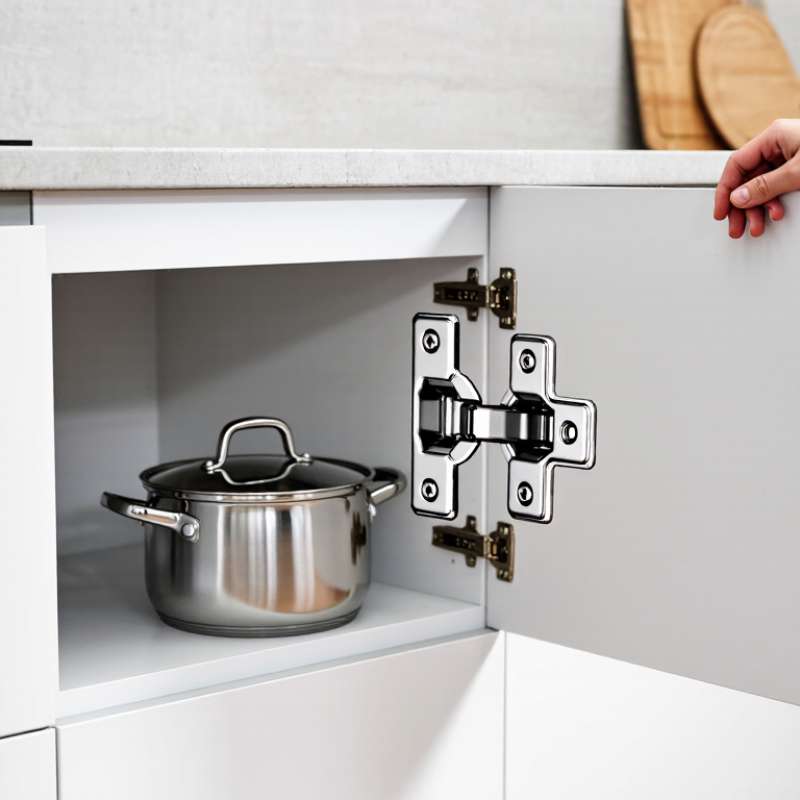
Why Choose a 180 Degree Concealed Hinge?

180° Opening Geometry: How Full-Access Travel Affects Cabinet Clearance

Why Choose a 180 Degree Concealed Hinge?

A 180-degree concealed hinge lets a cabinet door swing fully aside, widening access to shelves and drawers. The benefit is practical: a hand can reach a deep corner without the door blocking the opening. But 180 degrees describes hinge travel, not guaranteed wall clearance. Door thickness, frame geometry, handle projection, and nearby walls all affect the final position. Measure the actual cabinet and adjacent surfaces before specifying hardware. A drawing can look generous. Reality is less tidy.

The National Kitchen & Bath Association’s Kitchen Planning Guidelines specify work aisles of at least 42 inches for one cook and 48 inches for multiple cooks. Those figures concern the aisle, not hinge performance, but they show why open-door projection matters in a busy kitchen.

A door that parks across a walkway can make a well-sized aisle feel tight. Check the hinge’s stated opening angle and required clearance against the door width, then test a sample if the cabinet sits near a wall or appliance. Small detail. Easy to miss. And a full opening may still expose less usable shelf space than expected when stored items sit close to the cabinet edge.

35 mm Cup Bores: Checking Door Thickness and Mounting Compatibility

Why Choose a 180 Degree Concealed Hinge?

35 mm Cup Bores: Checking Door Thickness and Mounting Compatibility

A 35 mm cup bore describes the hole diameter, not the door thickness it can safely fit. Before drilling, check the hinge drawing for cup depth, edge setback, and the required door-thickness range. Many concealed hinges suit doors around 16–22 mm thick, but that range is not universal. A deep cup in a thin door can break through the face. Not a small mistake.

A wide-opening hinge also needs room beside the cabinet. Door thickness, overlay, side-panel position, and handle projection can limit the actual opening angle. EN 15570:2008 sets strength and durability test methods for furniture hinges; it does not make every 35 mm cup hinge interchangeable. Measure a sample door and confirm the mounting plate position against the hinge specification. Real cabinets can be slightly out of square, too, so perfect paper measurements may need adjustment.

Tips: Measure door thickness at several points. Mark the cup center from the door edge using the hinge’s drawing, then test-drill scrap material. Check the swing with the handle installed. A dry fit catches problems early.

Load Ratings in Kilograms: Matching Hinge Count to Door Mass and Width

A 180-degree concealed hinge can open a door fully, but its load rating must suit both the door’s mass and width. A wider door creates more leverage: a 40 kg door, 900 mm wide, produces about 177 Nm of static moment around the hinge axis, before impact or repeated use. This is a calculation, not a hinge capacity rating. EN 1935:2002 classifies applicable single-axis hinges by factors including durability and door mass; it does not make every concealed hinge interchangeable. Check the hinge’s own tested rating and installation conditions.

Adding hinges does not always divide the load evenly. The top hinge may experience extra pull-out force, especially on a tall, wide door that is opened quickly. A heavier door may need more hinges, but spacing, frame strength, fasteners, and hinge geometry matter too. One detail is easy to miss: confirm whether the stated kilogram rating applies to one hinge or to a specified set. If the door is unusually wide, ask the manufacturer for a configuration-specific rating.

Tips: Measure the finished door, including glass or cladding. Compare its mass and width with the hinge’s published limits, then follow the specified hinge count and spacing. Leave a safety margin. Real doors are not always perfectly balanced.

Durability Testing: Reading EN 15570 Requirements and Cycle Ratings

A 180-degree concealed hinge needs more than a wide opening angle; its arm, cup, and mounting screws must stay aligned through repeated movement. EN 15570:2008, the European standard for furniture hinge strength and durability, provides test methods for assessing performance. Its endurance test is commonly reported as 80,000 opening-and-closing cycles. One cycle means opening and closing the door once. That figure is useful, but it does not tell the whole story.

Ask for the test report, not just a cycle claim. Check whether the tested hinge matches your door’s weight, size, and mounting arrangement. A tall door can pull down on the hinge arm; a loose screw can turn smooth movement into a scrape against the cabinet side. Small details matter.

The report should identify the test standard, cycle count, load, and any damage or looseness found afterward. For a 180-degree model, also confirm that the test setup allowed the full opening range. A high cycle rating without comparable test conditions is hard to interpret. I would not treat the number alone as a guarantee; installation quality and daily use still matter.

Installation Data: Using Adjustment Ranges to Align the Cabinet Door

Why Choose a 180 Degree Concealed Hinge?

Installation Data: Using Adjustment Ranges to Align the Cabinet Door

A 180-degree concealed hinge lets a cabinet door swing wide, making interior shelves easier to reach. The final fit still depends on careful adjustment. Start with the cabinet level, then check the door reveal—the narrow gap around its edges. A 2–3 mm reveal is a practical target for many installations, but follow the cabinet plan and hinge instructions. Small differences show quickly. A pencil mark and feeler gauge can help track them.

Many concealed hinges offer lateral, height, and depth adjustment, often by only a few millimeters. Treat those figures as model-specific, not universal. ANSI/BHMA A156.9-2020 is an industry performance standard for cabinet hardware; it does not prescribe one adjustment range for every hinge. Check the hinge’s installation data sheet before drilling or changing settings. Adjust one axis at a time: shift the door sideways to even the gaps, raise or lower it to align the top edges, then move it inward or outward until it sits flush. Check again with the door open and closed. It can still look slightly off. That may be the cabinet, not the hinge.