How to Choose the Best Suction Vacuum for Your Business?
A commercial floor tells a story: fine dust gathers along shelving, grit catches in entry mats, and a full shift leaves debris in busy walkways. Choosing a Suction Vacuum is therefore more than a question of suction power. The right machine must match the floor type, cleaning schedule, staff capacity, and cost of ongoing maintenance.
ENERGY STAR reports that certified commercial vacuums use about 40% less energy than conventional models. That is a useful benchmark, not a promise that every certified unit will suit every site. The U.S. Bureau of Labor Statistics also counts roughly 2.4 million janitors and building cleaners in its occupational data. Together, these sources underline the scale of routine cleaning and the value of practical equipment choices.
A buyer should compare airflow, filtration, noise, cord length, dust capacity, and replacement-part availability. A lightweight upright may suit offices with carpet; a canister model may be easier around furniture and edges. Small details matter. A heavy unit can slow staff on stairs, while a poorly sealed bin can send dust back into the room. It is tempting to rank models by headline suction alone. That shortcut deserves a second look: real performance depends on the machine, the floor, and the operator. This guide explains how to weigh those factors and choose a vacuum that fits your business rather than simply buying the most powerful one.
Define Your Business’s Cleaning Needs
Before comparing suction vacuums, observe the dirt your team actually removes. Fine dust from an office carpet behaves differently from crumbs in a busy café or grit tracked across a warehouse floor. Start with the mess. Note the floor surfaces, debris types, and rooms cleaned each shift. Pay attention to corners, stairs, and spaces beneath desks, where cleaning is often rushed.
Measure the area and estimate how often each zone needs attention. A small, crowded workspace may need a compact vacuum that turns easily, while broad carpeted areas can make capacity and sustained suction more important. Check whether the machine can handle your usual debris without frequent blockages. If fine dust is common, review the filtration details and maintenance instructions rather than relying on a general performance claim. Test noise levels during normal business hours; a loud motor can disrupt staff or customers.
Think about who will use and maintain the vacuum. A heavy unit may work well on open floors but frustrate staff on stairs. Check cord reach, storage space, bag or bin changes, and access to replacement filters. These estimates are imperfect; real cleaning times often differ from a manager’s guess. Ask cleaners where the current routine breaks down, then trial a suitable unit in the busiest area before deciding.
How to Choose the Best Suction Vacuum for Your Business: Define Your Cleaning Needs
Start by identifying the size of the particles your business needs to remove. These benchmarks can help clarify whether your cleaning priorities are coarse debris, fine particulate matter, or filtration performance.
PM2.5 and PM10 indicate particle-size cutoffs. The 0.3 μm value is the test-particle size used for the DOE HEPA efficiency benchmark; it is not a vacuum performance rating. HEPA filters are rated to capture at least 99.97% of particles at that test size. Consider the debris and filtration needs of your own workspace when comparing vacuums.
Sources: World Health Organization particulate matter definitions; U.S. Department of Energy HEPA filter standard.
Compare Vacuum Types and Suction Performance
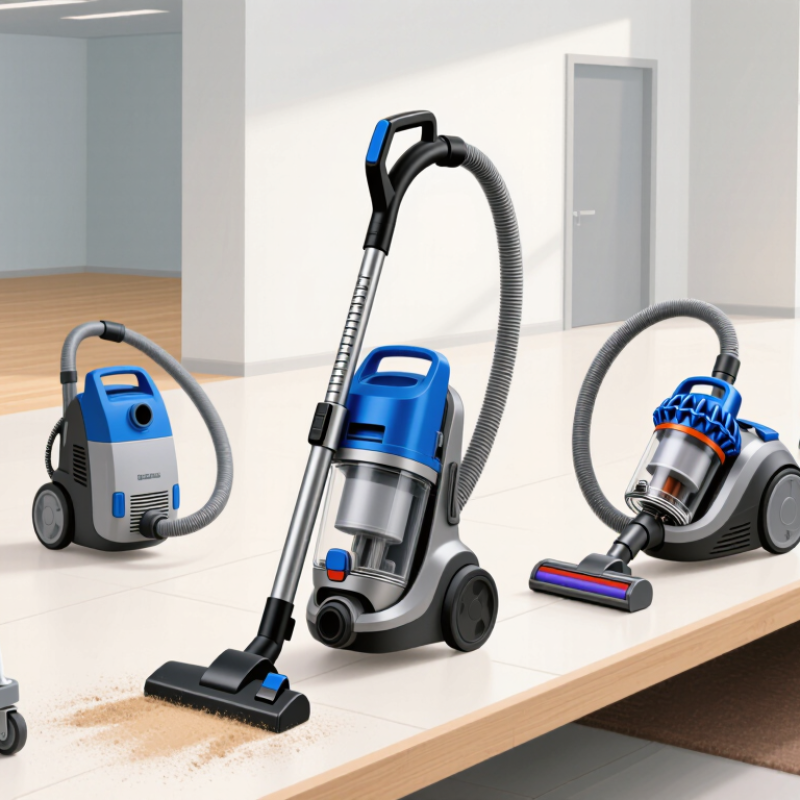
Choosing a business vacuum starts with the debris and surfaces it must handle. An upright model suits broad carpeted areas, while a canister often offers better reach around desks, stairs, and shelving. Wet-dry machines handle liquid spills and coarse debris, but they may be bulky for daily office cleaning. Backpack vacuums can help staff move through crowded spaces. Fit matters.
Suction performance is more than a single number. Sealed suction describes the machine’s ability to lift against resistance; airflow helps move dust and debris through the hose. A narrow or clogged hose can reduce real-world pickup, even when the motor rating looks impressive. Filter condition matters, too. Fine dust needs suitable filtration, while full bags and dirty filters can weaken performance. Check how quickly staff can inspect and replace them.
Test shortlisted vacuums on the actual flooring, using the debris your team sees: grit near an entrance, crumbs under chairs, or hair in carpet. Watch for repeat passes, awkward handling, and noise during normal work hours. Test it loaded. A strong showroom demonstration is not always a reliable guide, and peak suction alone can be easy to overvalue. Record the vacuum’s rated airflow and suction, then compare those figures with your trial results and maintenance needs.
Evaluate Filtration, Capacity, and Ease of Use
For a business vacuum, match filtration to the material and exposure, not just the label. The U.S. Department of Energy’s HEPA standard specifies at least 99.97% efficiency at 0.3 microns. That benchmark is useful for fine particles, but it does not make every vacuum suitable for every hazard. OSHA’s silica guidance, Table 1, specifies dust-collection requirements for certain tools, including 99% filter efficiency and a filter-cleaning mechanism. Check the applicable task requirements and the vacuum’s documentation. A number on a filter is only part of the story.
Capacity affects how often staff stop to empty the tank. Yet a large tank can be awkward in a crowded workshop. Consider the usable volume, the weight when full, and whether bags or containers can be changed without spilling dust. Airflow matters, too: a tank may look generous while a clogged filter weakens pickup. Test the unit with your actual debris. Small details count.
Ease of use shows up during a busy shift. Check hose reach, wheel movement over thresholds, filter access, and noise near workstations. A simple filter-cleaning routine can help maintain suction, but only if workers will use it. I would not choose by capacity alone; that shortcut is tempting, and sometimes wrong. Review the DOE HEPA performance criteria and OSHA silica guidance alongside the manufacturer’s test data, then compare models under realistic operating conditions.
Assess Durability, Maintenance, and Operating Costs
A suction vacuum can look inexpensive on a quote and still cost more over three years. Check the warranty, motor duty rating, hose material, and availability of filters and seals. Ask for the expected service interval under your actual daily workload. A machine used on fine dust for six hours per shift faces different wear than one used for occasional spills. Inspect the wheel mounts and hose couplings; these small parts often take the knocks. No spec sheet replaces a trial on your floor.
Maintenance affects operating costs, too. The U.S. Department of Energy’s Operations & Maintenance Best Practices Guide reports that effective maintenance programs can reduce energy costs by 5–20 percent across facilities. That figure is not vacuum-specific, so treat it as context, not a promised saving. ENERGY STAR’s commercial vacuum criteria also provide a useful efficiency benchmark: certified models use less energy than conventional products meeting the program’s comparison standard. Compare measured power, airflow, and runtime for the same task, rather than buying on motor wattage alone. Track filter changes, repair hours, and electricity use for a month. Real data can be untidy. Still, it may reveal that a cheaper unit’s frequent clogs are costing more than expected.
Match Safety Requirements and Budget to Your Needs
How to Choose the Best Suction Vacuum for Your Business?
Match Safety Requirements and Budget to Your Needs
Start with the material you need to collect, not the vacuum’s advertised power. Fine dust, damp debris, and metal shavings can require different collection systems. Check the material’s safety data and your workplace requirements before comparing models. For hazardous dust, confirm that the unit’s filtration and construction are suitable for the specific task. A high suction rating alone does not prove safe performance. Details matter.
Then consider how the vacuum will be used each day. A unit that runs for hours beside a production line may need durable filters and a large collection container. In a small workshop, a compact model may be easier to move between benches. Ask staff to estimate how often they empty containers and replace filters. These small tasks add up. I would not assume the cheapest model stays cheapest after months of use.
Set a budget that includes accessories, replacement filters, energy use, and possible downtime. Request clear maintenance intervals and check whether routine servicing can be handled in-house. Compare these costs against the purchase price. There is no perfect spreadsheet; actual debris and shift patterns can differ from estimates. A short trial in the intended work area may reveal issues that a specification sheet misses.